
Ancient games · New metro · Historic home
Piazza Duomo
& Palazzo Nanà.
At one Naples address, a Roman ceremonial complex lies below a 21st-century metro station while a late-19th-century palace keeps watch above.
Project visualization — not a current photograph. Proposed completed Piazza Nicola Amore and Duomo station dome · Studio Fuksas via Architizer
2K
The view from Palazzo Nanà spans almost two thousand years: the memory of Roman games, the grand city-making of the 1800s and Naples’ newest layer of public architecture.
One useful clarification before the story begins: Duomo station is in Piazza Nicola Amore, where Corso Umberto I meets Via Duomo. Travellers often search for “Piazza Duomo” because of the station and nearby cathedral; the official square outside the apartment is Piazza Nicola Amore.
01 · Place names made simple
Piazza Nicola Amore—the square many visitors meet as “Duomo”
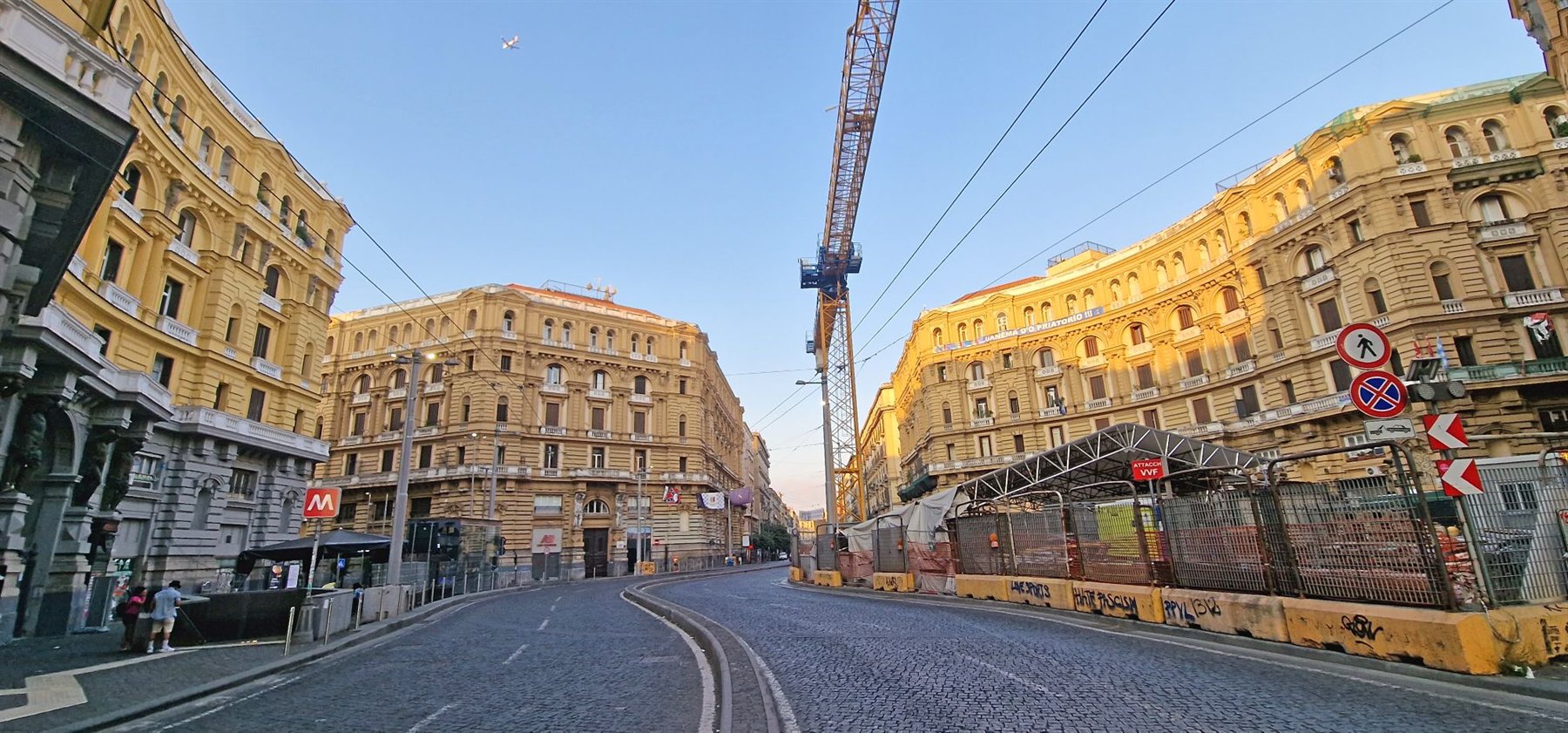
The circular piazza sits on Corso Umberto I at the foot of Via Duomo. Neapolitans also call it 'e quatto palazze, “the Four Palaces,” after the four monumental neo-Renaissance buildings that frame its corners.
The square received its modern form during the Risanamento, the vast urban renewal that reshaped parts of Naples after the 1884 cholera epidemic. The new buildings and broad Corso Umberto I expressed a modernising city, but the ground beneath them preserved a much older public landscape.
Why this matters to guestsPalazzo Nanà occupies one of these historic palace blocks at Piazza Nicola Amore 2. Duomo station’s entrance is immediately outside, while the cathedral lies a short walk north along Via Duomo.
02 · Two millennia in one block
A timeline beneath the balcony
- Greek & Roman Naples
A public edge of ancient Neapolis
The area lay just beyond the earliest city walls and developed into a place of movement, ceremony and civic life. The later Roman monumental complex was connected with the games held in honour of Augustus.
- 17th century
Piazza della Sellaria
The area carried the name of the Sellaria and its fountain, a reminder that the square’s identity changed with Naples’ rulers, markets and public rituals.
- 1880s–1890s
The Risanamento and “Four Palaces”
The modern circular piazza and its four matching neo-Renaissance palace blocks were created during the late-19th-century redevelopment. Palazzo Nanà dates from this chapter.
- 1938
A monument leaves the square
The statue of Nicola Amore—the mayor associated with the Risanamento—was moved for Hitler’s visit to Naples and was not returned to its former place.
- 2003–2004
Metro excavation becomes archaeology
Work for the new station exposed substantial Roman remains. The discovery required the architects and engineers to rethink the station as a journey through archaeology, not simply around it.
- 6 August 2021
Duomo station opens
Line 1 service began at Duomo, putting Garibaldi, the historic centre, Municipio, Toledo and Vomero on one direct route from the square.
03 · The city under the city
What archaeologists discovered at Duomo Metro
The finds are not a single loose object but evidence of a monumental ceremonial and athletic complex. Sources describing the excavation identify four especially important elements:
An imperial-age podium
The base of a temple associated with the imperial cult and the games, generally dated to the early Roman imperial period.
A Flavian colonnade
Remains of a portico from the Flavian period helped define the monumental public space around the sanctuary.
Part of the running track
A section linked with the gymnasium and athletic course shows that this was also a place of competition and training.
Greek winner inscriptions
Inscribed fragments preserve names and events from the Neapolitan Isolympic Games, giving individual competitors a voice across centuries.
What were the Isolympic Games?
Naples’ Sebastà, or Augustan Isolympic Games, followed the model and prestige of the games at Olympia. “Isolympic” means equal in status to the Olympic tradition. Athletic and cultural contests celebrated Augustus in a city that retained a strong Greek identity under Roman rule.
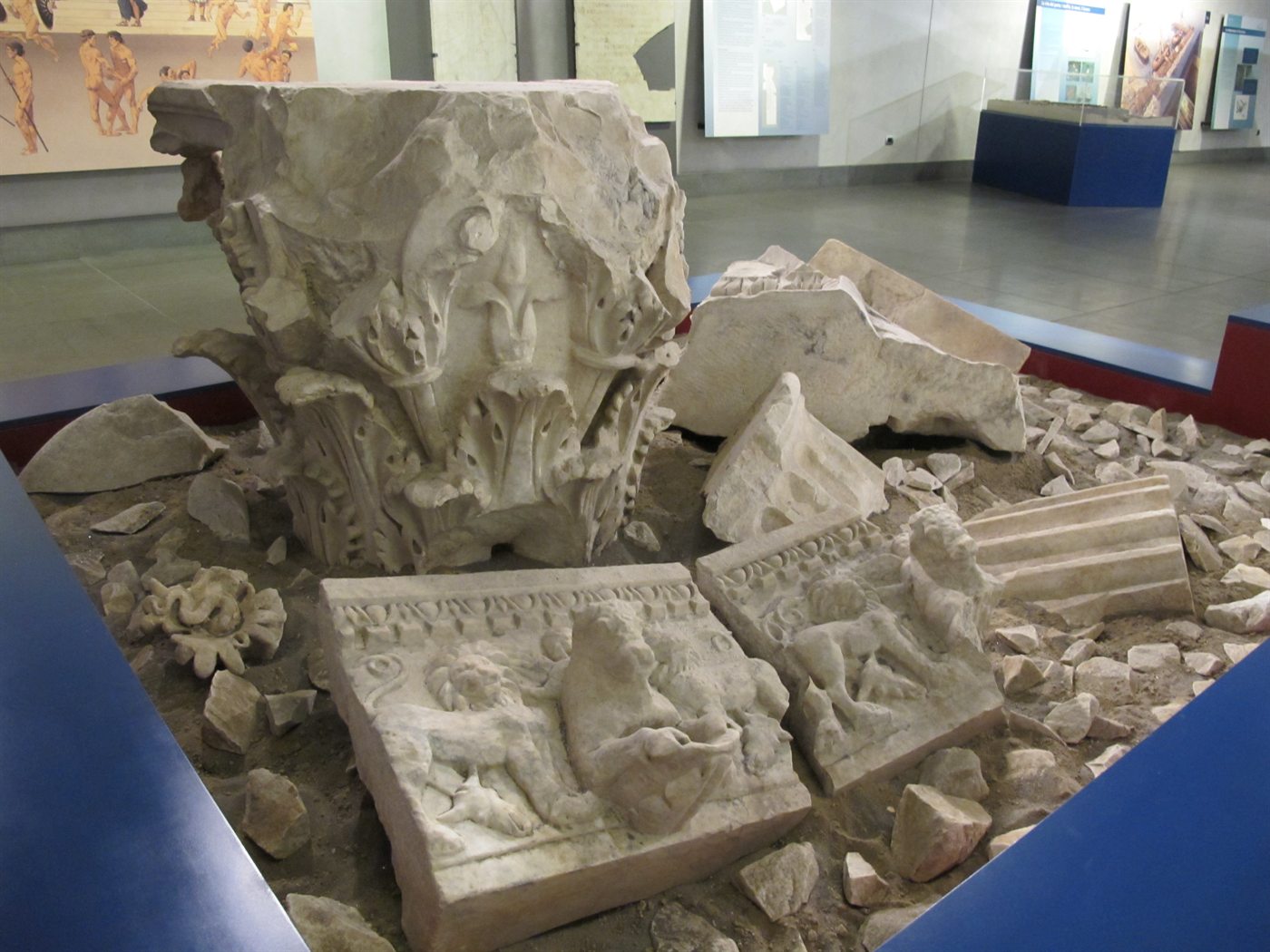
This is a documentary photograph of archaeological material from the Naples Metro excavations, preserved and displayed at Stazione Neapolis. The museum collection includes finds from the Line 1 works at Piazza Nicola Amore; the temple podium and other structural remains described above were preserved in situ beneath Duomo station.
04 · Fuksas below the piazza
The new Duomo station: an “astronaut’s walk”
Doriana and Massimiliano Fuksas designed the station as a changing passage from daylight into the city’s buried layers. Backlit and carved steel panels move through cool blue and warm amber tones; reflective metal amplifies the light, while travertine floors and lava-stone stairs reconnect the futuristic interior to Campanian materials.
The platforms are about 40 metres below street level. That depth turns an everyday trip into a sequence: piazza, light, museum level, transport level, train. The archaeological discovery radically changed the project, with the surviving Roman structures intended to remain legible within the station experience.
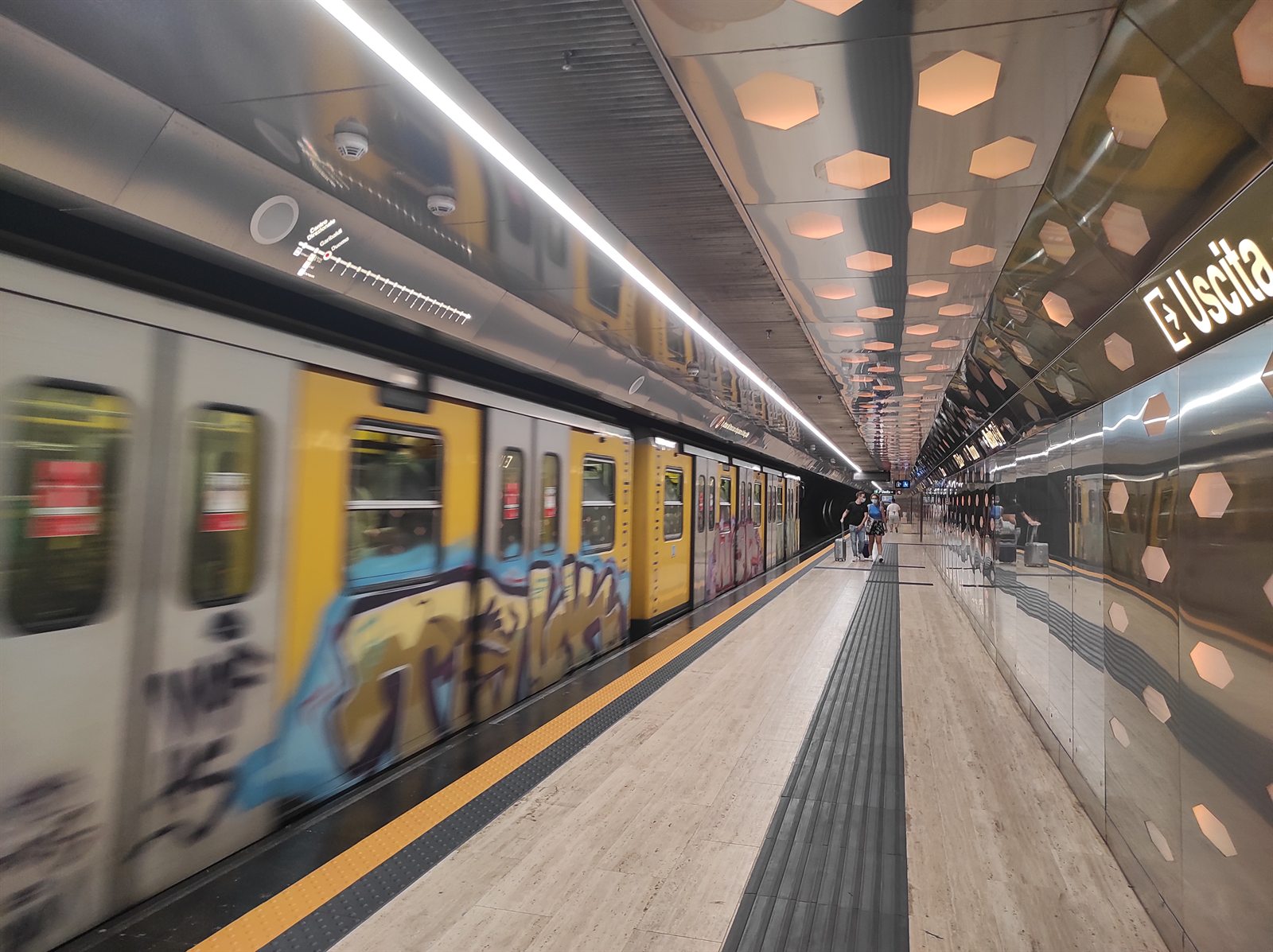
Look, then rideEven if you are not taking a train, the station entrance helps explain the square. If you are travelling, Line 1 runs one stop to Garibaldi in one direction and directly to Università, Municipio, Toledo, Museo and Vanvitelli in the other. See our complete Naples Metro guide.
05 · Stay inside the history
Palazzo Nanà: a late-19th-century Naples address
Historic period: late 1800s. Architectural publication THE PLAN identifies Palazzo Nanà as one of the Four Palaces built at the end of the nineteenth century. Its exterior belongs to the neo-Renaissance language chosen for the new bourgeois city: balanced façades, formal ornament and a monumental scale around an internal courtyard.
The building has eight levels including its basement and originally formed part of the residential vision for the redesigned square. A recent Eight Lab project renovated its 80 apartments, preserving the historic envelope while bringing contemporary services, materials and energy standards inside.
c. late 19th century
A historic palace, not a themed hotel
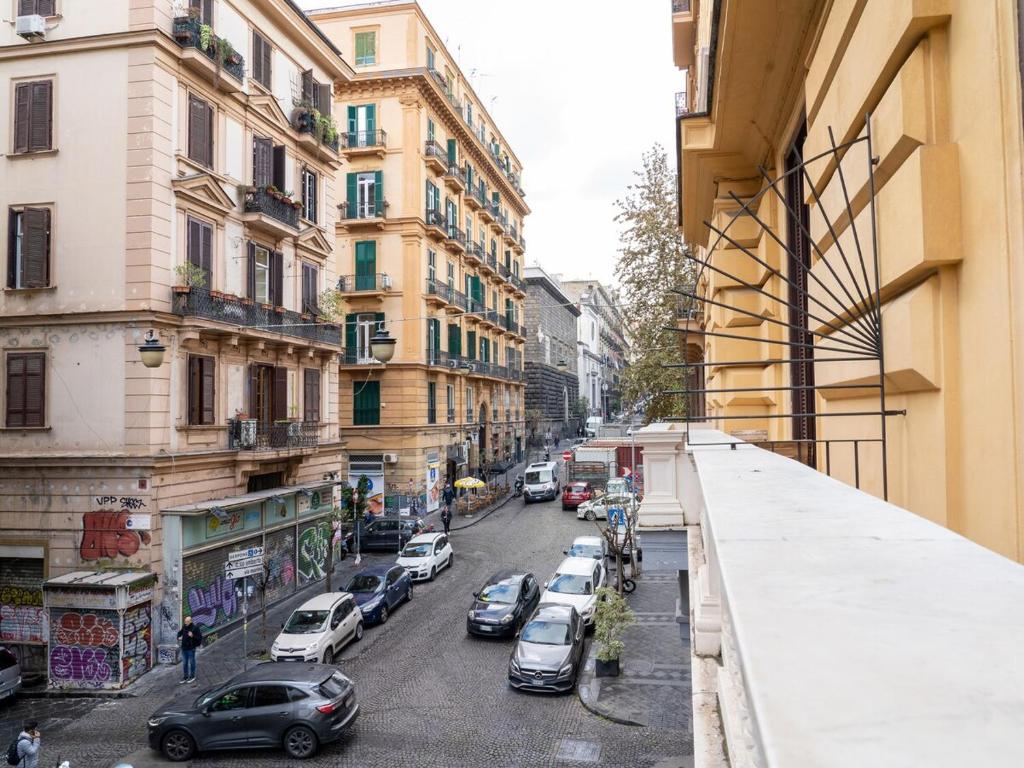
Holidays a Napule is an independent apartment within this living residential landmark. Guests experience the proportions and address of the historic building with the comfort of a renovated two-bedroom home.
Explore the apartmentThe name Nanà belongs to the building’s contemporary identity; the deeper architectural identity is the Quattro Palazzi ensemble. That is why the best way to tell its story is through both names: Palazzo Nanà, one of Piazza Nicola Amore’s historic Four Palaces.
06 · A five-minute field guide
How to read the square from our front door
- Stand at the centre line of the piazza. Turn slowly and compare the four palace blocks. Their shared scale creates the theatrical “Four Palaces” effect.
- Find the Duomo station entrance. Notice how its contemporary geometry deliberately contrasts with the stone façades around it.
- Enter and watch the colour change. Blue, silver and amber guide the descent; travertine underfoot recalls the archaeological layer.
- Walk north on Via Duomo. The cathedral, the Museum of the Treasure of San Gennaro and the ancient decumani are all close.
- Return after dark. The square’s traffic, illuminated façades and station light reveal a different, more cinematic composition.
07 · Quick answers
Piazza Duomo and Palazzo Nanà FAQ
Is the apartment really beside Duomo Metro?
Yes. Palazzo Nanà is at Piazza Nicola Amore 2, with the Duomo Line 1 station entrance approximately ten metres from the building.
Is Piazza Nicola Amore the same as Piazza Duomo?
The official square is Piazza Nicola Amore. “Duomo” is the Metro station name and refers to nearby Via Duomo and the cathedral area, so visitors often use Piazza Duomo informally when searching for the location.
Can I see the Roman temple today?
The station was conceived to integrate and reveal the archaeological remains, but visible areas and access can change as museum and piazza works progress. Treat the station itself as the visit and follow on-site access signs.
What year was Palazzo Nanà built?
The strongest architectural source dates it to the end of the nineteenth century rather than publishing one exact year. We therefore describe its construction honestly as the late 1800s, during the Risanamento era.
Who designed Duomo Metro station?
The station was designed by architects Doriana and Massimiliano Fuksas. It opened for Line 1 service on 6 August 2021.
08 · Researched, not invented
Sources for the history
- Studio Fuksas — Duomo station concept, depth, materials and 2004 temple discovery
- designboom — station opening and archaeological findings
- THE PLAN — Palazzo Nanà’s late-19th-century history and renovation
- Visit Naples — Piazza Nicola Amore and the Four Palaces
- ANM Metro Art — official Duomo station archaeology and design guide
Every feature image on this page is a real documentary photograph. Dates and licences are stated in the captions so readers can distinguish the 2020 works, the 2021 station opening and the completed 2024 street view.
Ride the cityMetro guide
Every key line, interchange, ticket choice and route from Duomo station.
 Sleep in the story
The apartment
Two bedrooms, two bathrooms and a historic-city address inside Palazzo Nanà.
Late 1800s outside · Today inside
Stay in
Palazzo Nanà.
Make Piazza Nicola Amore, Duomo Metro and the historic centre your front doorstep.